
Origin Story
-
Where It Started
Kane was conceived during Calanmai after his mother was chosen during the Rite by the High Lord of Spring, Tamlin’s father. Though she already had a mate waiting for her at home, it was not uncommon for females from smaller villages near the Petalfield Estates to participate in the old traditions surrounding Calanmai. She returned to her husband afterward believing the child would simply be raised as theirs, and for a time, that was exactly what happened. But from infancy, Kane was noticeably different from other children. His emotions triggered strange bursts of magic, and his strength developed far too quickly for his age. As he grew older, rumors quietly spread through the nearby villages that the boy carried the High Lord’s blood. Terrified that someone from the Spring Court would eventually notice his abilities and take him away, his parents fled deeper toward the borderlands and raised him in near-total isolation.
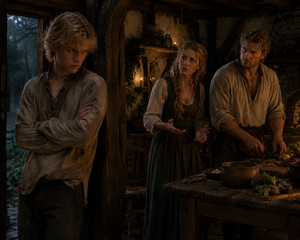 The isolation only worsened the problem. Kane grew up with little understanding of civilization, restraint, or control. His parents tried desperately to hide what he was while possessing no real understanding of the powers surfacing inside him. By the age of eleven, those powers had already begun manifesting physically during moments of stress. The first true incident happened during an argument with his mother inside their forest cabin. Kane became overwhelmed with rage and panic, and in a moment of blind emotion, he grabbed a heavy object and hurled it across the room. It struck his mother hard enough to crack her skull against the stone hearth, killing her instantly.
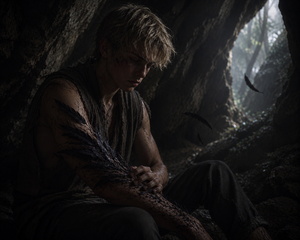 The shock, grief, fear and anger triggered his first uncontrolled transformation. Massive eagle-like wings erupted from his back and arms, stretching from fingertip to spine while feathers burst through skin and shattered every window in the cabin outward. At the same time, his feet twisted violently into enormous talons capable of splitting wood beneath him. Moments later, his father rushed inside and discovered the scene only to find his son half-shifted and standing over his mother’s body. Grief immediately turned to fear. When his father reached for a weapon, Kane lashed out instinctively in terror. By the end of the panic, his father lay dead beside her. Kane fled into the forests alone that same night.
-
Learning Alone
For years afterward, he survived within the wilderness bordering the Spring Court, hiding inside cave systems he had explored as a child while wandering near the cabin. Though still young, he possessed enough practical knowledge to survive. His father had taught him how to start fires, identify trails, skin game, and avoid predators long before the tragedy occurred. The caves became his shelter, and over time the forests became more familiar to him than any home ever had. Isolation slowly stripped away what little civilization remained in him. He stopped speaking for long stretches, he slept on stone ledges or curled near fires, and learned to track through scent and sound rather than sight. By adulthood, Kane moved through the forests like something they had raised themselves.
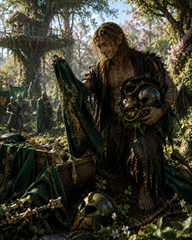 Everything changed when Hybern soldiers began moving through the Spring Court during the war. Kane became fascinated by them almost immediately. From the safety of the trees, he watched their camps for weeks at a time, studying their routines, punishments, arguments, and the strange structure of military life. Eventually curiosity became interference. He began raiding their camps while soldiers were distracted, first stealing food and blankets before moving on to tools, weapons, rope, lanterns, tents, bunks, and anything else that interested him. Often he remained nearby afterward, hidden in the trees and quietly amused while the soldiers screamed accusations at one another over the missing supplies.
 At first, Kane attempted to build his shelter low within the forest, but the sounds of construction repeatedly drew Hybern patrols toward him. Every investigation ended the same way. The soldiers never returned. Kane quickly learned that remaining close to the ground made him vulnerable, so he adapted. At the same time, he struggled to understand how to actually use the materials he had stolen. He initially tried forcing structures together with his bare hands, breaking fingers and bones more than once in the process. Rocks and sharpened sticks proved useless. Frustrated but determined, Kane began stalking Hybern camps specifically to observe how soldiers used tools. He learned by watching, by stealing, and of course, by experimenting.
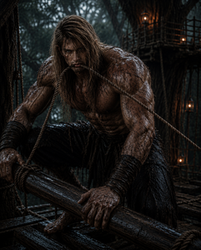 Eventually, he abandoned the caves entirely and began constructing a massive shelter high within the canopy itself. The structure stretched across six enormous trees connected through rough wooden platforms, rope bridges, salvaged beams, and stolen rigging from Hybern camps. The tents had been ripped apart and resewn together to create enclosed sleeping areas protected from rain and snow. Mattresses, military bunks, stolen furs, crates, lanterns, and scavenged furniture slowly transformed the structure into something halfway between a predator’s nest and a hidden village suspended above the forest floor. The tallest point of the structure, Kane’s watchtower, sat nearly one hundred feet above the ground, hidden deep within the upper canopy where movement and light became almost impossible to detect from below. His private sleeping area sat slightly beneath it, large enough for him to properly sleep, store supplies, and maintain heat during winter. The higher Kane built, the safer he felt.
-
Mortals....?
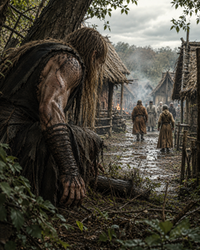 When the war finally ended and the wall between realms collapsed, the Hybern soldiers disappeared. Some returned home. Some marched toward battlefields they never left. Others simply vanished into the chaos of war. Kane suddenly found himself alone again for the first time in a long time. That was when he realized there had ever been a wall at all. To Kane, the collapse of the barrier did not feel political or historical. It simply meant there was suddenly more world beyond the forests he knew. And within that world were humans. He, once again, became obsessed with them immediately.
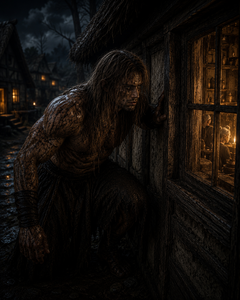 The Hybern soldiers had been the only humanoid creatures Kane had knowingly observed up close before then, making the discovery of true humans endlessly fascinating. He did not understand what they were, only that they behaved differently. He began stalking villages at night, watching through windows, stealing abandoned objects, and dragging anything interesting back into the forests to study. Rain barrels. Axes. Lanterns. Buckets. Fabric. Rope. Tools. If he could carry it and did not understand it, he took it. Kane was not graceful during these explorations. Branches snapped beneath his weight, heavy footsteps echoed through rooftops and fields, strange cries and movement followed him through the darkness, terrifying the humans long before they ever saw him directly. At first, the thefts were harmless, and seemingly meaningless.
Then came the livestock.
The first animal died accidentally. Kane approached a cow out of curiosity, attempting to inspect it more closely, only for the frightened creature to kick him hard enough to trigger an instinctive violent reaction. Kane killed it brutally before fully understanding what had happened. But afterward, he observed the humans more carefully. He watched them milk cows, slaughter others for meat, gather eggs from chickens, sometimes killed and ate the chicken, and herd goats into pens. Slowly, he learned the purpose of each animal and how valuable they were to the humans around them. Once he understood their usefulness, the raids became intentional. Kane began stealing livestock for milk, eggs, meat, and hides, killing whenever necessary and dragging whatever he needed back into the forests. -
The Boogeyman
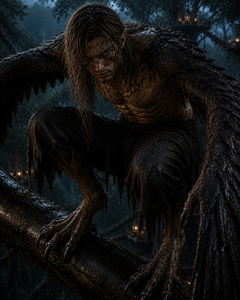 Eventually, the villages organized hunting parties to track the creature responsible. The hunters followed trails of feathers, blood, bones, snapped branches, and massive footprints leading back toward the old fae lands near the collapsed wall. Few ever found anything beyond the edge of the forests. Fewer still returned with answers. Over time, rumors began spreading through the mortal villages of a savage fae creature that stalked the woods at night and stole children from their beds. Parents began warning their children not to wander after dark. Songs appeared. Stories passed between villages. The Boogeyman near the wall. The thing that lived in the trees.
Kane never understood why they feared him so deeply. But he did learn one important thing. Humans reacted violently when they saw him. So he adapted once again. And after that, he made certain they almost never did.
Once Kane began raiding the mortal lands regularly, curiosity eventually dragged him back toward the abandoned battlefields left behind after the war. By then, he understood enough about soldiers and tools to recognize that battlefields often meant supplies, weapons, and salvage left scattered among the dead. The first expedition proved successful. No humans, no fae, and no interruptions. Kane scavenged everything he could physically carry and hauled it back into the forests to inspect, dismantle, and study within the safety of his treehouse. Rusted weapons, broken armor, rope, lanterns, old tents, shattered shields, strange metal tools, and crates filled with unfamiliar objects all disappeared into the canopy one piece at a time.
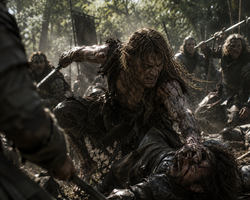
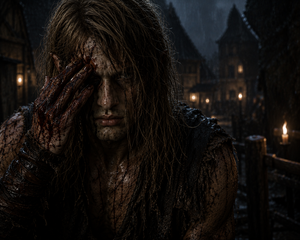 The second visit did not go as smoothly. By then, the humans had grown brave enough to begin scavenging the battlefields themselves, desperate to reclaim weapons, valuables, and anything useful left behind after the war. Kane entered the clearing believing they would react the same way most humans always had before: panic, fear, retreat. Instead, they fought back. It was that day Kane learned the greatest weakness fae possessed: Ashwood. Confident in his own strength and utterly inexperienced with true resistance from mortals, Kane charged directly toward the group in an attempt to scare them off. What he failed to notice was the human hidden farther back among the wreckage holding a bow fitted with a single ashwood arrow salvaged from the battlefield itself. The arrow flew before Kane could react. It embedded directly into his left eye with enough force to destroy both the eye and his vision instantly.
The pain was unlike anything he had ever experienced.
Kane’s scream tore through the battlefield loud enough to scatter nearby animals from the forests entirely. Rage and terror consumed him almost immediately afterward. Half-blind, disoriented, and driven completely feral by pain, he lost what little restraint he possessed and slaughtered every human present. By the time the violence ended, the battlefield had become a massacre site. Blood, broken bodies, feathers, and torn flesh created a gruesome trail leading all the way back toward the forests surrounding the old wall. -
A Horrific Injury
 Removing the arrow proved nearly as horrific as the wound itself. At first, Kane instinctively tried to grip the shaft with his bare hand, only to discover the ashwood burned his skin on contact. The pain shot through him violently enough to force him backward, and every attempt to touch the arrow directly left blistered burns across his fingers and palm. Eventually, desperate and panicking, Kane wrapped a strip of animal hide around the arrow to shield himself from direct contact. Then he pulled, and the motion ripped the ruined eye free alongside the arrow itself.
Kane’s screams echoed through the forests for hours afterward, long and animalistic enough to silence entire sections of woodland around him. Though High Fae healing magic eventually sealed the wound itself, nothing could regenerate the eye he had torn free during the removal. Left with an empty socket and irritated by debris entering the injury, Kane fashioned crude bandages from torn clothing and wrapped them tightly around his head for protection.
The eyepatch came much later.
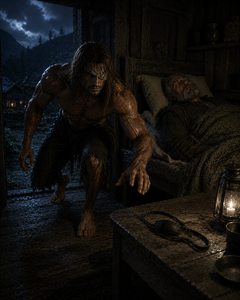 During one of his regular nighttime stalkings near the mortal villages, Kane noticed an older human male wearing a black patch of fabric over one eye. Fascinated by the concept and recognizing its usefulness almost immediately, Kane decided he wanted it for himself. But by then, he had grown far more cautious around humans and what they were capable of doing to him. Instead of attacking openly, Kane waited until the old man fell asleep before silently breaking into the house during the middle of the night. He stole the eyepatch directly from beside the man’s bed and vanished back into the forests before sunrise.
He wore it ever since.