Please log in to participate in Epic Week challenges.

This topic is for discussing clues and potential answers to the Divination Symbol in Epic Week 2026. Please stay on topic. Remember, these riddles are designed to be challenging and require a group of people brainstorming together; don't feel intimidated if you don't know the answer right away. Every little idea can help. Research is not cheating; it is expected!
Click here to visit the location of the Divination Symbol
Click here to visit the location of the Divination Symbol

Edit for clarity, later: In reference to the second clue!!
After looking up the "liber secvndvs" directly, the etymology has me thinking it could be the second chapter or book of something? I don't know if the riddles get that crazy, but I was also pulling up things like
>academic archives of 19th century books on latin grammar
>works by horace and vergil
So maybe looking into old translations of runic texts could get somewhere?? The format also seems a bit reminiscent of the way one cites academic texts-- to me, at least!! But I could be way off!!
I also managed to find a bit of a connection to the infamous Cicada 3301 puzzle game, as there was a puzzle that utilized runes, but that feels a bit out of left field 😅
After looking up the "liber secvndvs" directly, the etymology has me thinking it could be the second chapter or book of something? I don't know if the riddles get that crazy, but I was also pulling up things like
>academic archives of 19th century books on latin grammar
>works by horace and vergil
So maybe looking into old translations of runic texts could get somewhere?? The format also seems a bit reminiscent of the way one cites academic texts-- to me, at least!! But I could be way off!!
I also managed to find a bit of a connection to the infamous Cicada 3301 puzzle game, as there was a puzzle that utilized runes, but that feels a bit out of left field 😅

Mmmm Kay. So I was right. The runes are Nordic. (They looked Nordic at a glance)
The first clue is a “bind rune”, usually engraved on weapons to bring victory. Is associated Tyr and represents things like justice, honour and doing things for the greater good.
The first clue is a “bind rune”, usually engraved on weapons to bring victory. Is associated Tyr and represents things like justice, honour and doing things for the greater good.

The symbols make me think of, like, alchemy. Along with the symbol theme, could also be some other sorcery or summoning sort of thing.
The third set of symbols is pretty much always all non-fiction, so whatever it is, it's something from history that was believed real in its time.
Or, ya know... the theme could be a huge red herring and it could be chemistry symbols or something, but more likely to be something outdated.
The third set of symbols is pretty much always all non-fiction, so whatever it is, it's something from history that was believed real in its time.
Or, ya know... the theme could be a huge red herring and it could be chemistry symbols or something, but more likely to be something outdated.
I’ve got dnd rn but the other symbols are a cool writing systems that allows you to write large numbers in one character
Use this site.
You need to use each “part” to make the number (first one is 19 I think)
Which also means it’s chapter 19 of a book I think ((leaning to Troy or ceasar ngl)
Use this site.
You need to use each “part” to make the number (first one is 19 I think)
Which also means it’s chapter 19 of a book I think ((leaning to Troy or ceasar ngl)
SaharaSunset wrote:
Mmmm Kay. So I was right. The runes are Nordic. (They looked Nordic at a glance)
The first clue is a “bind rune”, usually engraved on weapons to bring victory. Is associated Tyr and represents things like justice, honour and doing things for the greater good.
The first clue is a “bind rune”, usually engraved on weapons to bring victory. Is associated Tyr and represents things like justice, honour and doing things for the greater good.
You know... I'll admit I dismissed Nordic stuff pretty fast because they didn't match any of the letters. I sort of forgot that other runes that weren't just letters, ya know, also existed.

I also dismissed nordic stuff far too quickly!! But if all of the other runes are numbers, maybe the first one is, too??
In which case, the clues could be: Appeared in 1533(?? A bit iffy on this one!), Liber Secvndus (Book the second?), cap. 19, p. 142 (or p. 233 if translated)
So maybe books/other texts published 1533 in latin/greek?
In which case, the clues could be: Appeared in 1533(?? A bit iffy on this one!), Liber Secvndus (Book the second?), cap. 19, p. 142 (or p. 233 if translated)
So maybe books/other texts published 1533 in latin/greek?

chapter 8 page 142 (or 233 in translation)
the coding appeared in 1533 if you look at cistercian numbers (online decoder)
I found the original Buggary act from King Henry VIII is from 1533
Janus Secundus wrote Basiorum Liber (book of kisses) in 1533 (the book of secundus; Secundus Liber), I know this goes far
But kisses have been given many centuries before...
On page 142 line 8 says: [Kisses] undefiled/unpolluted by any ravishments
just some volatile thoughts
the coding appeared in 1533 if you look at cistercian numbers (online decoder)
I found the original Buggary act from King Henry VIII is from 1533
Janus Secundus wrote Basiorum Liber (book of kisses) in 1533 (the book of secundus; Secundus Liber), I know this goes far
But kisses have been given many centuries before...
On page 142 line 8 says: [Kisses] undefiled/unpolluted by any ravishments
just some volatile thoughts
When I see "cap." I think "caption" rather than "chapter."

We may be looking at Heinrich Cornelius Agrippa's Three Books of Occult Philosophy.
https://en.wikipedia.org/wiki/Three_Books_of_Occult_Philosophy
1. Published in Latin in 1533.
2. The second book is about celestial magic, which of course is historically correlated to divination.
3. A section is dedicated to Cistercian numerals (the ones in use in the clues) specifically wherein he discusses their use in magic.
A recent translation exists, by one Eric Purdue.
The "originating order" I believe would be the Cistercians themselves, who designed these numerals and, being a Catholic order of monks, did not intend that they be used in magic or attributed any magical qualities.
https://en.wikipedia.org/wiki/Cistercians
https://en.wikipedia.org/wiki/Three_Books_of_Occult_Philosophy
1. Published in Latin in 1533.
2. The second book is about celestial magic, which of course is historically correlated to divination.
3. A section is dedicated to Cistercian numerals (the ones in use in the clues) specifically wherein he discusses their use in magic.
A recent translation exists, by one Eric Purdue.
The "originating order" I believe would be the Cistercians themselves, who designed these numerals and, being a Catholic order of monks, did not intend that they be used in magic or attributed any magical qualities.
https://en.wikipedia.org/wiki/Cistercians
"Divination" feels like it might be a tone setter....maybe something like Agrippa's "Third Book of Occult Philosophy (1533)" or something similarly magicky? "Cap" definitely seems like it must be "chapter", if this archive of the text is anything to go by: https://archive.org/details/DeOccultaPhilosophiaLoc1533/page/n141/mode/2up
I can't make heads or tails of the actual text though, and the "cap" is 13, pg. 142-- not 8 or 19. So beyond that, I'm lost 😅
I can't make heads or tails of the actual text though, and the "cap" is 13, pg. 142-- not 8 or 19. So beyond that, I'm lost 😅
ARCHITECT wrote:
We may be looking at Heinrich Cornelius Agrippa's Three Books of Occult Philosophy.
https://en.wikipedia.org/wiki/Three_Books_of_Occult_Philosophy
1. Published in Latin in 1533.
2. The second book is about celestial magic, which of course is historically correlated to divination.
3. A section is dedicated to Cistercian numerals (the ones in use in the clues) specifically wherein he discusses their use in magic.
A recent translation exists, by one Eric Purdue.
The "originating order" I believe would be the Cistercians themselves, who designed these numerals and, being a Catholic order of monks, did not intend that they be used in magic or attributed any magical qualities.
https://en.wikipedia.org/wiki/Cistercians
https://en.wikipedia.org/wiki/Three_Books_of_Occult_Philosophy
1. Published in Latin in 1533.
2. The second book is about celestial magic, which of course is historically correlated to divination.
3. A section is dedicated to Cistercian numerals (the ones in use in the clues) specifically wherein he discusses their use in magic.
A recent translation exists, by one Eric Purdue.
The "originating order" I believe would be the Cistercians themselves, who designed these numerals and, being a Catholic order of monks, did not intend that they be used in magic or attributed any magical qualities.
https://en.wikipedia.org/wiki/Cistercians
Ayy, same thought!! This must be the right track. I feel like we may need the next clue before this can go any further...
EDIT: It's there! I was too deep in the forum replies, oops!
Quote:
The originating order may have quibbled with these attributions given by the author.
Does "originating order" refer to a sequence or an organization? In context, it sound more like an organization.
The"author" mentioned is probably the author of the book. Sounds like maybe the author attributed something done by the "originating order" to someone else? I can think of other ways to read it, but that's how I think it makes the most sense.
Other ways to read it I can think of offhand:
- The author attributed something to the order that the order would not want credit for.
- The author attributed qualities/aspects to something that came from the order, which the order might disagree with.
- The author's attributions don't match up with a sequence of release.
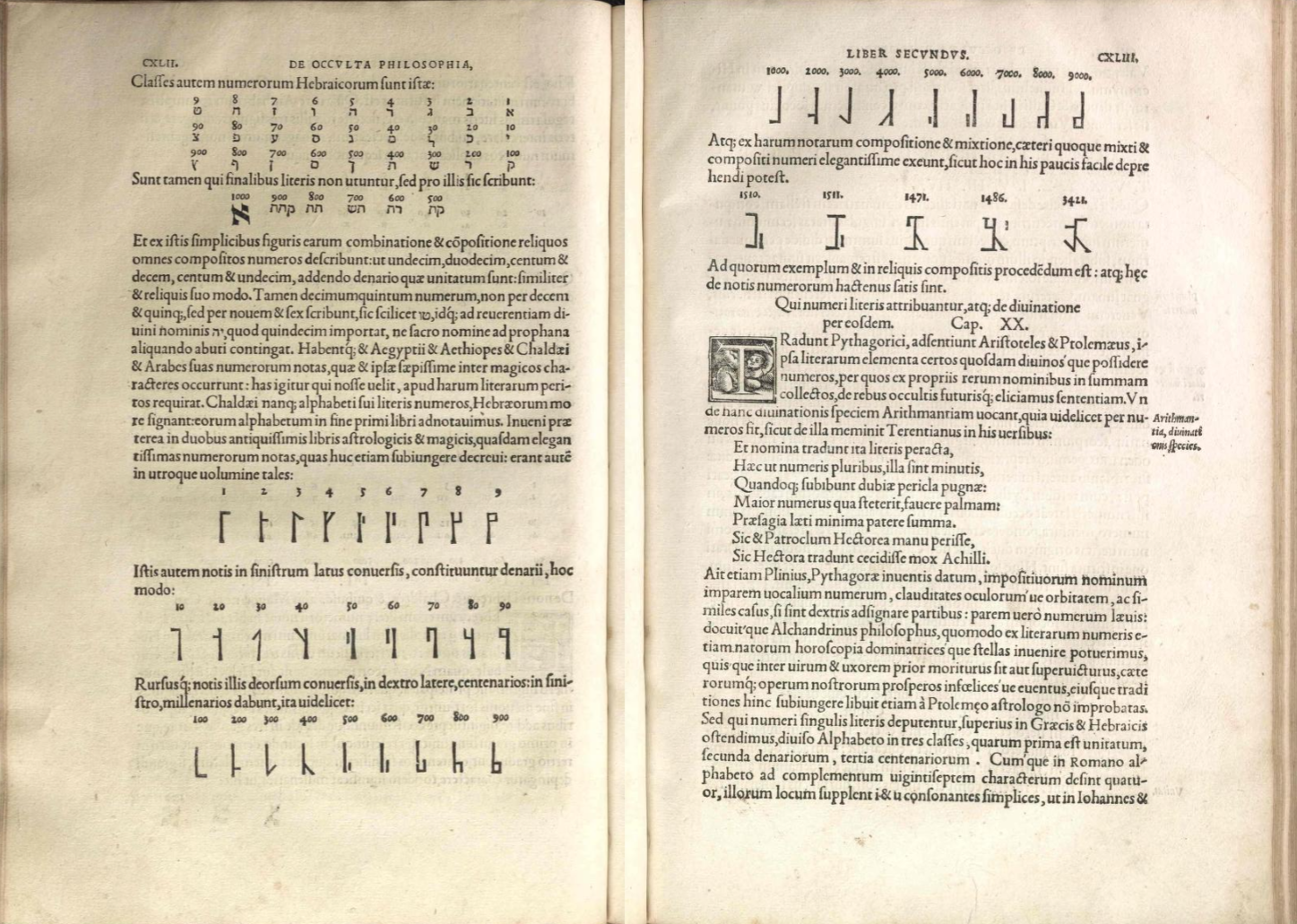
Page 142 (CXLII) is actually page 158 on the archive.org scans!
And, what do you know, those figures there sure look familiar.
And, what do you know, those figures there sure look familiar.
ARCHITECT wrote:
Page 142 (CXLII) is actually page 158 on the archive.org scans!
And, what do you know, those figures there sure look familiar.
And, what do you know, those figures there sure look familiar.
No wonder I was confused!! Look at that, they're the same... Thank you!!
The pages in question.
Translated.
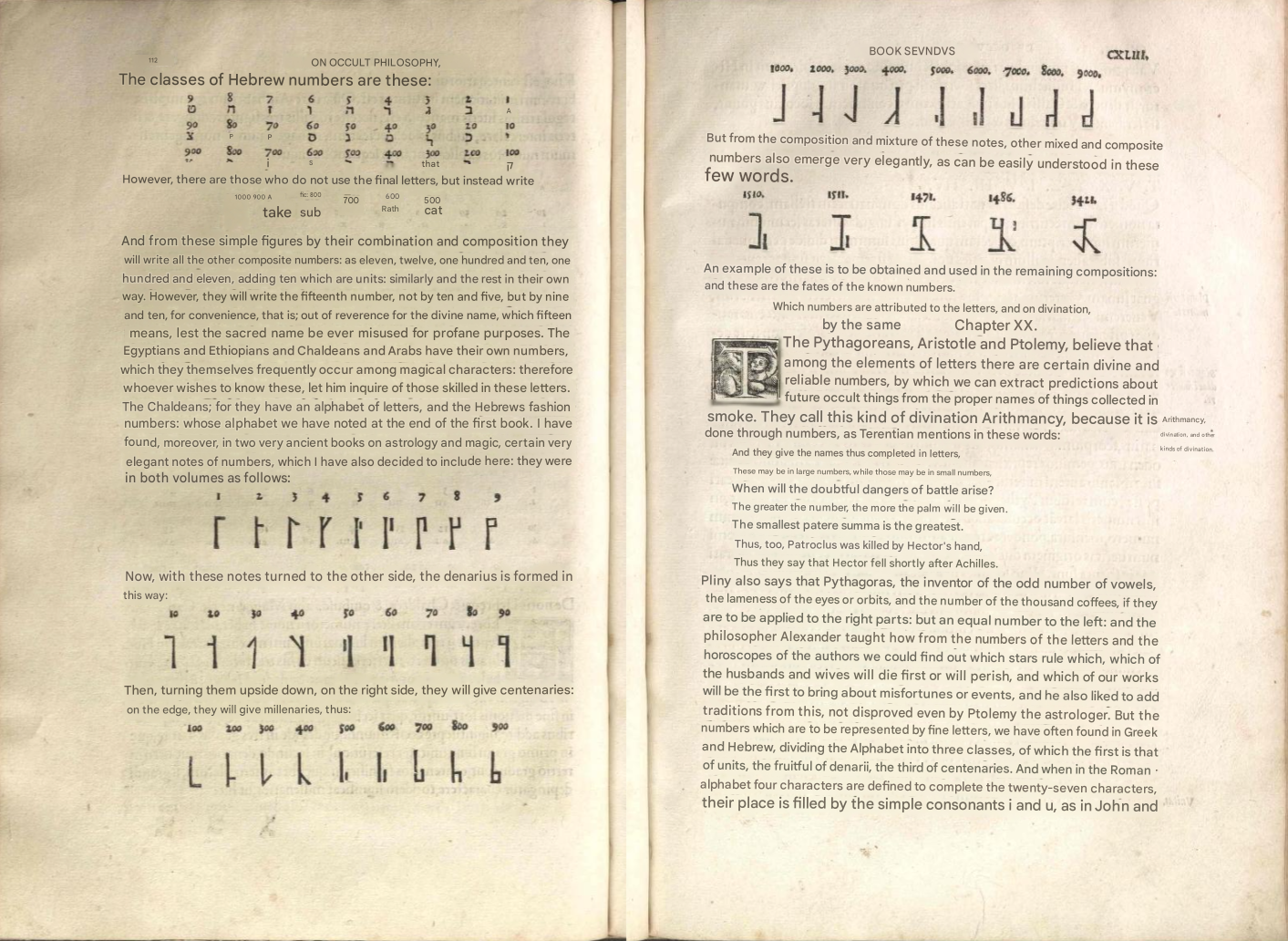
(You might want to right click -> open in new window to read them.)
Edit: Having gazed upon these pages myself, one possible answer could be Arithmancy, divination through the use of numbers.
ARCHITECT wrote:
Edit: Having gazed upon these pages myself, one possible answer could be Arithmancy, divination through the use of numbers.
I think that would make the most sense-- although I think Cistersians or Pythagoreans in reference to the last hint could also be worth trying!!
but what's the 8? maybe ∏ or number pi

Zelphyr wrote:
When I see "cap." I think "caption" rather than "chapter."
This is a Latin inscription, and the Latin word for chapter is capitulum
Hm! We guessed many things and it was none of them.
Another possible solution could be Gematria, that is, the translation of a word or a phrase into a number, or Isopsephy, the combination of multiple numbers derived from gematria into a single number; these numbers are then used in various types of magic, or to divine the natures of things.
Other writing systems mentioned on the cited page include Hebrew and Arabic, which are themselves historically associated with both of these.
Another possible solution could be Gematria, that is, the translation of a word or a phrase into a number, or Isopsephy, the combination of multiple numbers derived from gematria into a single number; these numbers are then used in various types of magic, or to divine the natures of things.
Other writing systems mentioned on the cited page include Hebrew and Arabic, which are themselves historically associated with both of these.
You are on: Forums » Epic Week 2026 » Divination Symbol (SOLVED)